
From Chlorine to Carnegie Hall
This essay concludes the four-movement series, From Chlorine to Carnegie Hall.
Coda: A Final Reflection
Music didn’t enter my life all at once. It arrived in fragments: through a swimming pool speaker, a movie theater, a car stereo, and a late-night television band. None of those moments felt especially important at the time. They were ordinary. Accidental, even.
I didn’t understand most of what I was hearing at the time. I just kept listening.
Looking back now, I can see how fragile each of those moments was. Any one of them could have gone the other way. I could have missed the swim lesson. Gone to a different movie. Left that cassette at home. Turned the TV off early.
But someone helped keep the door open. Sometimes a parent. Sometimes a teacher. Sometimes just being in the right place at the right time.
That’s the part I think about most now, especially as a teacher.
A lot of music education focuses on outcomes: proficiency, achievement, advancement. Those things matter. But long before any of that, students need exposure. They need time to live with the music before anyone tries to explain it.
Somewhere along the way, I found myself at Carnegie Hall in ways I never could have imagined as a kid listening to cassette tapes in the back seat of my parents’ car.
In 2015, my orchestral tone poem Kākū, kūpala | Fear in Neutral Buoyancy was premiered there by the Youth Philharmonic International Orchestra, conducted by José Luis Gómez. I was seated in the balcony with my family, listening as the piece unfolded. At the end of the performance, Maestro Gómez invited me to stand and take a bow.
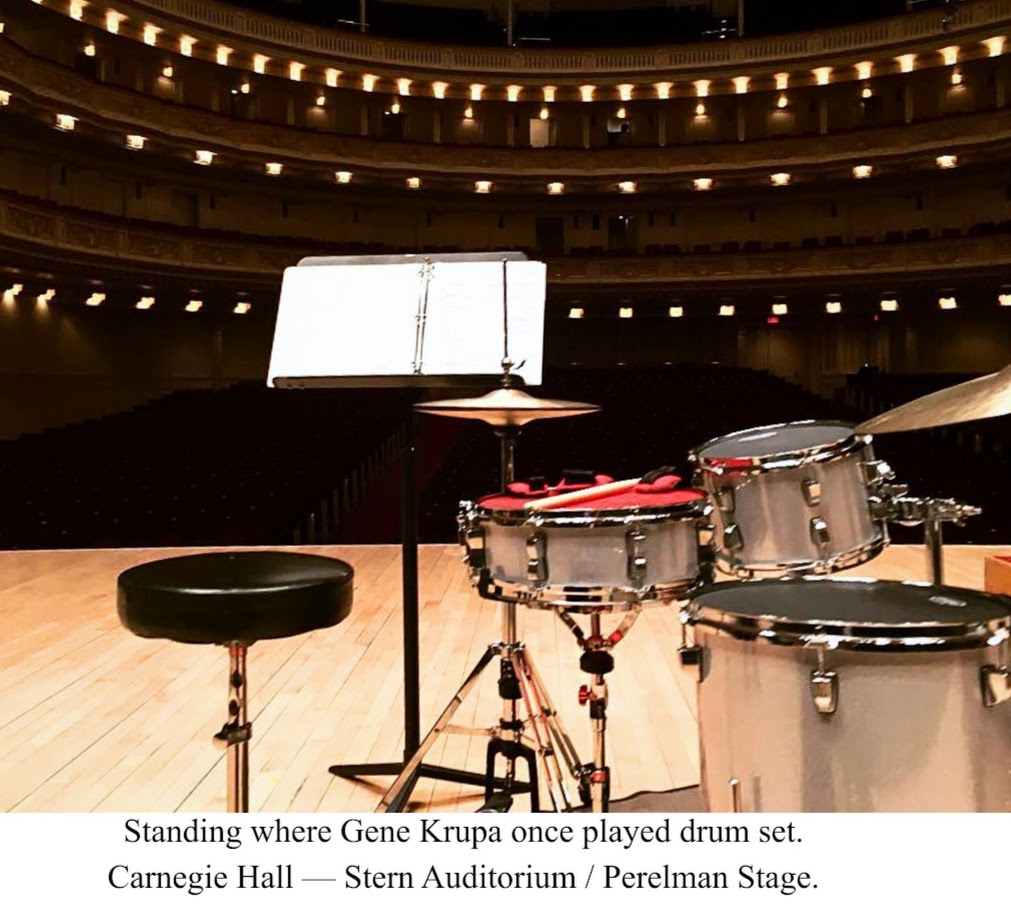
A few years later, I returned to the same stage as a performer, playing drum set with the Philadelphia Boys Choir and Chorale. Standing there, I couldn’t help but think about the Benny Goodman recording that had once played through a pair of headphones in the back seat of a car.
Looking out over the hall I had first encountered through recordings, I felt the weight of that stage. It was a privilege to stand in a place where so many giants of music had made history, including the musicians whose recordings had first sparked my journey.
I’ve been fortunate to perform in many remarkable venues, but none carried quite the same sense of history as Carnegie Hall.
If this series has taught me anything, it is that the most important role we can play, whether as parents, educators, or mentors, is not to predict where the path will lead. It is simply to keep the path open.
I didn’t walk through the door because I knew what was on the other side.
I walked through because someone made sure it stayed open.
Before you move on, try something.
Maybe it’s “Baker Street.”
Maybe it’s the Star Wars theme.
Maybe it’s “Sing, Sing, Sing.”
Maybe it’s “Begin the Beguine.”
Choose one recording that once meant something to you.
Sit with it longer than you normally would.
Listen without distraction.
New to the series? Start with Movement I: The Chlorine and “Baker Street” Epiphany.